
Teacher quality and certification play a crucial role in shaping the effectiveness of Indonesia’s education system. Teachers are not only responsible for delivering curriculum content but also for fostering critical thinking, motivation, and lifelong learning skills among students. The quality of teaching directly influences learning outcomes, especially in a country as diverse and geographically vast as Indonesia.
Despite ongoing reforms, significant challenges remain in ensuring that all teachers meet national competency standards and receive adequate professional support. Certification programs and continuous training initiatives aim to address these gaps, yet their impact varies widely across regions. To understand how this issue fits into the broader national context, it is helpful to explore the bigger picture of education in Indonesia, where teacher quality remains a key factor in achieving equitable and sustainable learning outcomes.
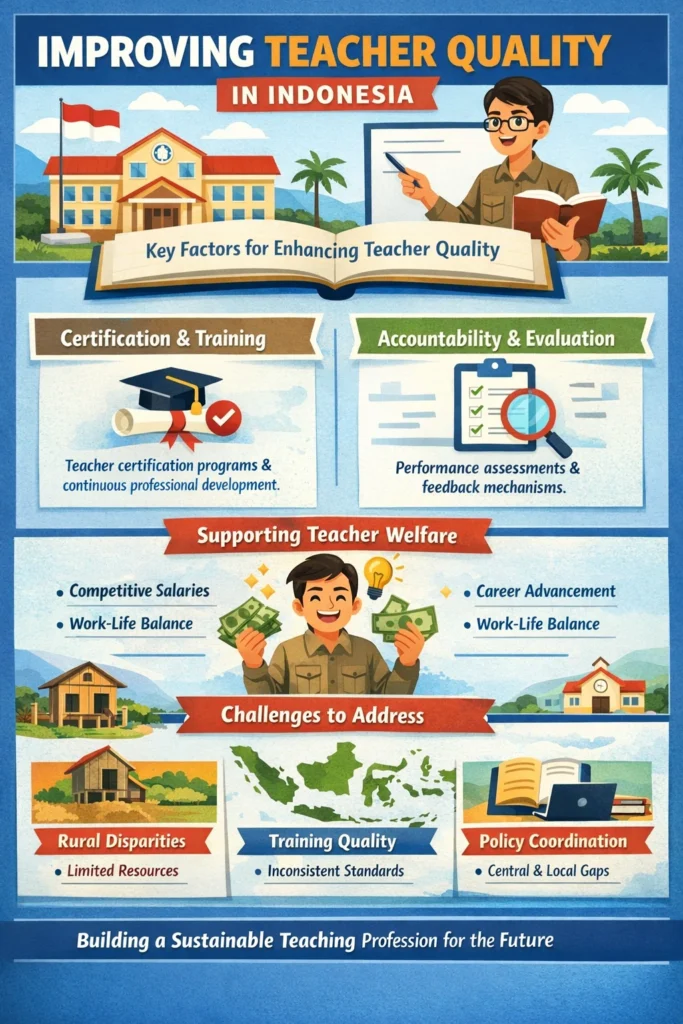
QUICK VIEW
Understanding Teacher Quality in Indonesia
The Role of Teachers in Student Achievement
Teachers are one of the most influential factors in determining student achievement within the education system. Their mastery of subject matter, teaching strategies, and classroom management skills directly shape how effectively students absorb and apply knowledge.
In Indonesia, where classrooms often include students from diverse cultural and linguistic backgrounds, teachers play a critical role in adapting lessons to different learning needs. Effective teachers can create inclusive learning environments that encourage participation, curiosity, and critical thinking.
Research and classroom experience consistently show that students taught by well-prepared and motivated teachers tend to perform better academically. This highlights why improving teacher quality is essential for raising overall educational outcomes nationwide.
Regional Disparities in Teacher Quality
Teacher quality in Indonesia varies significantly between regions, particularly when comparing urban centers with rural and remote areas. Schools in major cities usually have better access to qualified teachers, training opportunities, and teaching resources.
In contrast, many schools in remote regions face shortages of certified teachers and limited professional development support. Geographic isolation, difficult living conditions, and lack of infrastructure often discourage experienced teachers from working in these areas.
These disparities contribute to unequal learning outcomes across the country. Without targeted policies to improve teacher distribution and support in underserved regions, educational inequality is likely to persist.
Pre-Service Teacher Education
Pre-service teacher education forms the foundation of teacher quality in Indonesia. Prospective teachers typically undergo formal training at teacher education institutions, where they learn subject knowledge, pedagogy, and basic classroom management skills.
Although national standards guide teacher education programs, the quality of training institutions can differ considerably. Some graduates enter the workforce with limited practical teaching experience, making it difficult for them to manage real classroom challenges.
Strengthening pre-service education through improved curricula, longer teaching practicums, and closer supervision can help ensure that new teachers are better prepared before they begin their professional careers.
Teacher Certification System in Indonesia

Purpose of Teacher Certification
Teacher certification in Indonesia is designed to ensure that educators meet nationally defined professional and competency standards. The system aims to validate teachers’ academic qualifications, pedagogical skills, and professional ethics across all levels of education.
Beyond quality assurance, certification also serves as a policy tool to improve teacher welfare. Certified teachers are eligible for professional allowances, which are intended to increase motivation and encourage long-term commitment to the teaching profession.
In principle, certification is expected to raise overall teaching standards and create a more professional and accountable education workforce throughout the country.
Certification Requirements and Process
To obtain certification, teachers must meet specific academic and administrative requirements, including minimum educational qualifications and years of teaching experience. They are also required to demonstrate competency through assessments that evaluate pedagogical, professional, social, and personal skills.
The certification process typically involves portfolio evaluations, professional training programs, and performance assessments. These components are designed to measure both theoretical knowledge and practical teaching ability.
However, the implementation of these procedures can vary between regions, depending on local capacity, access to training centers, and administrative support.
Challenges in Certification Implementation
Despite its intended goals, the teacher certification system faces several implementation challenges. In some cases, certification is perceived as a bureaucratic requirement rather than a pathway to genuine professional development.
Inconsistent assessment standards and limited monitoring reduce the system’s effectiveness in improving classroom practices. As a result, certification does not always translate into better teaching performance or student outcomes.
Addressing these challenges requires stronger oversight, clearer evaluation criteria, and continuous support to ensure that certification contributes meaningfully to teacher quality and educational improvement.
Professional Development and Teacher Training
In-Service Training Programs
In-service training programs are designed to support teachers throughout their professional careers. These programs typically include workshops, seminars, and short courses that focus on curriculum updates, assessment methods, and classroom management strategies.
In Indonesia, in-service training is often organized by local education offices or the Ministry of Education. While these initiatives aim to improve teaching quality, their effectiveness varies depending on the duration, relevance, and follow-up support provided.
Short-term training without continuous mentoring or evaluation often limits long-term impact. For professional development to be effective, training programs need to be sustained and closely connected to classroom practice.
Digital and Online Training Opportunities
Digital and online training opportunities have expanded access to professional development for teachers across Indonesia. Online platforms allow educators to participate in courses, webinars, and virtual communities without geographical constraints.
Government-supported platforms and private EdTech providers offer training in digital literacy, innovative pedagogy, and the use of educational technology. These resources became particularly important during and after the COVID-19 pandemic.
However, unequal internet access and limited digital infrastructure remain challenges, especially in rural areas. Ensuring equitable access to online training is essential for reducing professional development gaps among teachers.
Mentoring and Peer Learning
Mentoring and peer learning programs emphasize collaboration and shared professional growth among teachers. Experienced educators provide guidance and practical advice to newer teachers, helping them navigate classroom challenges more effectively.
Peer learning communities encourage teachers to exchange ideas, reflect on teaching practices, and solve problems collectively. These interactions often lead to more context-specific and practical solutions than formal training alone.
When well-structured and supported, mentoring and peer learning can strengthen teacher confidence, improve instructional quality, and foster a culture of continuous improvement within schools.
Impact of Teacher Quality on Educational Equity
Learning Outcomes and Student Motivation
Teacher quality has a direct impact on student learning outcomes and overall academic achievement. Well-prepared teachers are more likely to use effective instructional strategies that help students understand complex concepts and apply their knowledge critically.
High-quality teaching also influences student motivation and engagement. Teachers who create supportive and interactive learning environments encourage students to participate actively and develop a positive attitude toward learning.
In contrast, limited teaching skills and reliance on rote methods can reduce student interest and hinder cognitive development. Improving teacher quality is therefore essential for strengthening both academic performance and student motivation.
Reducing Regional and Social Disparities
Qualified and well-supported teachers play a crucial role in reducing regional and social disparities in education. In disadvantaged communities, effective teaching can help compensate for limited resources and infrastructure.
Strategic deployment of skilled teachers to underserved areas has the potential to narrow learning gaps between urban and rural schools. Incentives, professional support, and career development opportunities are key to attracting teachers to these regions.
Without improvements in teacher quality and distribution, existing inequalities in access to quality education are likely to persist and deepen over time.
Long-Term National Development
The impact of teacher quality extends beyond individual classrooms and affects long-term national development. Education systems with strong teaching forces are better positioned to produce a skilled and adaptable workforce.
In Indonesia, improving teacher quality supports the development of human capital needed for economic growth, technological innovation, and social cohesion. Teachers help shape the values, skills, and competencies of future generations.
Investing in teacher quality is therefore not only an educational priority but also a strategic investment in the country’s sustainable development and global competitiveness.
Policy Reforms and Future Directions
Government Initiatives and Reforms
The Indonesian government has introduced various initiatives to improve teacher quality and professionalism. Policies such as curriculum reform and the Merdeka Belajar framework aim to give teachers greater flexibility in designing learning experiences that suit local contexts and student needs.
Reforms also focus on improving teacher recruitment, training, and certification systems. Efforts are being made to simplify administrative procedures and align professional development programs more closely with classroom realities.
Despite these initiatives, effective implementation remains a challenge. Consistent policy execution and coordination between central and local governments are essential to achieving meaningful improvements in teacher quality.
Strengthening Accountability and Evaluation
Accountability and evaluation are critical to ensuring that policy reforms translate into better teaching practices. Regular performance evaluations help identify strengths, address weaknesses, and support continuous professional growth among teachers.
Clear and transparent evaluation criteria allow teachers to understand expectations and improve their instructional methods. Feedback mechanisms, when applied constructively, can encourage professional reflection rather than compliance-driven behavior.
Strengthening accountability systems also helps maintain public trust in education reforms by ensuring that resources and incentives lead to tangible improvements in classroom learning.
Building a Sustainable Teaching Profession
Long-term improvement in teacher quality requires building a sustainable and attractive teaching profession. Clear career pathways, competitive compensation, and opportunities for advancement are essential to retaining talented educators.
Professional support systems, including mentoring, ongoing training, and access to teaching resources, help teachers adapt to changing educational demands. These supports contribute to job satisfaction and professional resilience.
By investing in teacher welfare and career development, Indonesia can strengthen the teaching profession and ensure the long-term sustainability of its education system.
FAQ About Teacher Quality and Certification in Indonesia
What is teacher certification in Indonesia?
Teacher certification in Indonesia is a formal process that ensures teachers meet national competency standards in pedagogy, subject knowledge, and professional ethics. Certified teachers are officially recognized as professional educators.
Why is teacher quality important in Indonesia’s education system?
Teacher quality directly affects student learning outcomes, motivation, and educational equity. High-quality teachers help reduce learning gaps, especially between urban and rural areas, and support long-term national development.
How does teacher certification affect teacher salaries in Indonesia?
Certified teachers in Indonesia are eligible for professional allowances in addition to their base salary. This incentive aims to improve teacher welfare and encourage professionalism, although its impact on teaching quality varies.
What challenges exist in Indonesia’s teacher certification system?
Challenges include inconsistent implementation, uneven access to certification programs, limited monitoring, and cases where certification does not lead to improved classroom performance, especially in remote regions.
How is the Indonesian government improving teacher quality?
The government is improving teacher quality through curriculum reform, professional development programs, digital training platforms, and policy initiatives such as Merdeka Belajar, which emphasizes flexibility and teacher autonomy.
Conclusion
Teacher quality and certification are fundamental to the success of Indonesia’s education system. While certification and professional development initiatives have helped establish national standards, their impact depends heavily on effective implementation, continuous support, and equitable access across regions.
Persistent challenges such as regional disparities, inconsistent training quality, and limited accountability highlight the need for sustained policy commitment. Strengthening pre-service education, in-service training, and evaluation systems is essential to ensure that certification leads to real improvements in classroom practice.
By prioritizing teacher quality as a long-term investment, Indonesia can improve learning outcomes, reduce educational inequality, and build a stronger foundation for national development. A well-supported and professional teaching workforce remains key to preparing future generations for an increasingly complex and globalized world.
For a deeper understanding of how teacher distribution and educational resources shape learning outcomes across different regions, explore our comprehensive article on Educational Disparity in Indonesia. This article examines the root causes of inequality in learning opportunities and highlights ongoing policy efforts to bridge regional and social gaps.
If you’re interested in how different schooling environments influence teacher recruitment, quality, and student achievement, read our in-depth discussion on Private vs Public Schools in Indonesia. It provides practical insights into how public and private education systems shape learning experiences across the country.
Trusted Academic References on Teacher Quality and Certification
Enhancing Teacher Quality in Indonesia: A Systematic Literature Review of the PPG Prajabatan Program Perspectives. Tedy Kurniadi. This review examines how the PPG Prajabatan program enhances teacher pedagogical skills and challenges in implementation. https://doi.org/10.22437/langue.v3i2.43683
Peningkatan Partisipasi Guru Pada Pendidikan Dasar Melalui Sertifikasi Guru. Loso Judijanto et al. Analyzes how teacher certification affects teacher participation and engagement in basic education. https://doi.org/10.31004/joe.v6i4.5742
Implementation of Teacher Certification in Improving the Quality of Education in MAN 1 Bogor Regency. Nurbaiti Dwi Sulistiya Rini. Field study on teacher certification’s role in school-level education quality improvement. https://doi.org/10.36456/bp.vol18.no2.a5491